OpenClaw Episode 4: Building the Board
How asking my personal AI assistant to break a personal site mission into smaller tasks turned OpenClaw from a chat experiment into a practical system for orchestrating AI agents, using heartbeat checks, tracking real work, and imagining how the same pattern could apply to team development projects.
The idea would not leave me alone. I needed a Kanban board for my AI agents.
Not a full project management tool. Nothing like Jira or Notion. I had spent enough years in product to know that heavyweight process kills momentum, especially when the team is just you and some agents on an old MacBook.
What I wanted was something simple. Three columns: To Do, In Progress, Done. Enough to see what was happening for every task. Just a Kanban board.
The personal site revamp became the first real project to run through it. I had the implementation plan from the earlier conversation with my personal AI assistant - Henry. Architecture, design phases, tech stack decisions, build steps.
So I asked Henry to break the plan down. Not as one big mission, but into smaller tasks that could actually move one by one. From there, my role became clearer. I would look at the mission control board, ask Henry to get the team to work on it, and then progress through the work task by task.
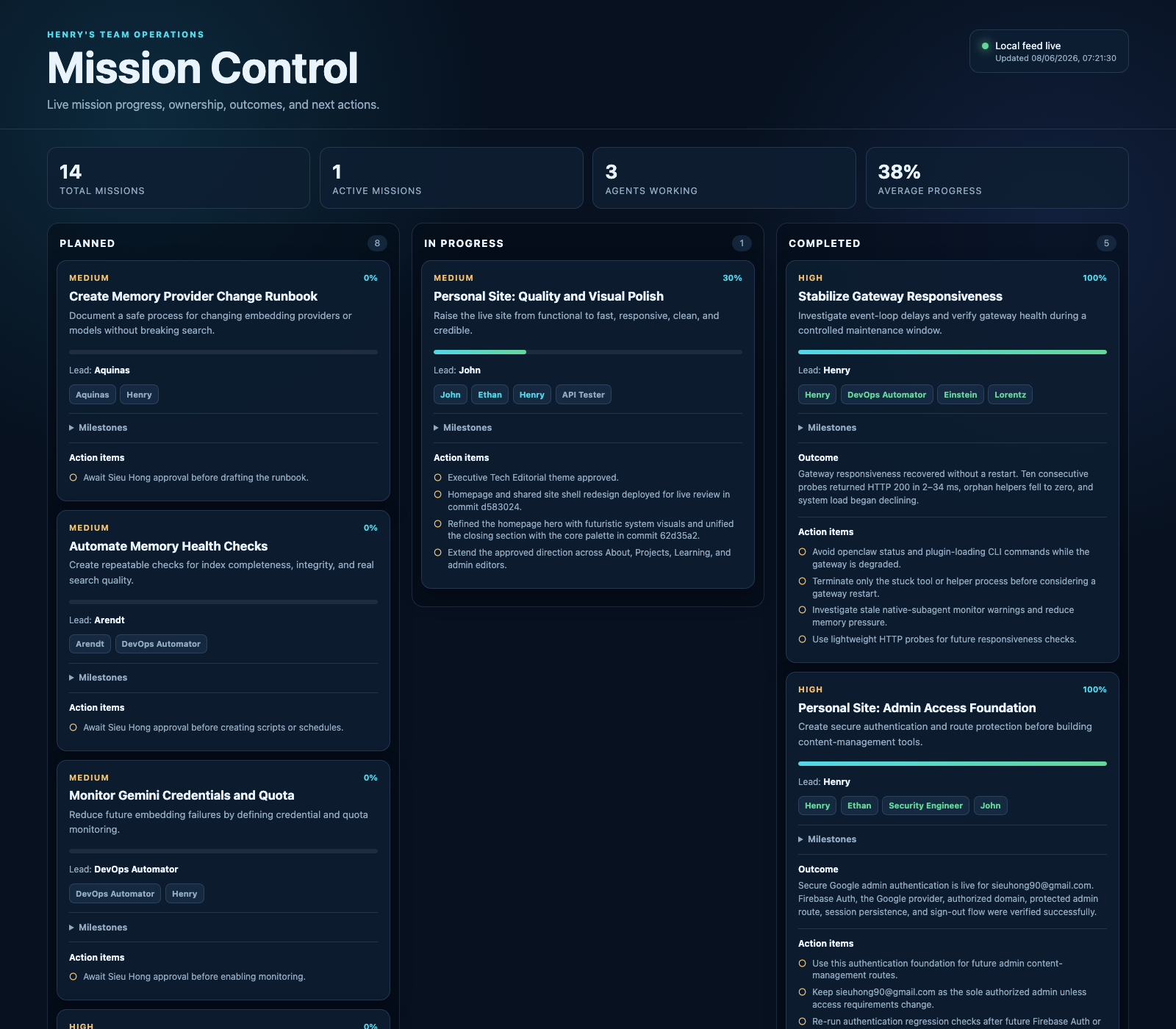
Once the tasks were visible, I could start assigning them. Some went to agents that could write code. Some went to agents that could handle UI/UX design with best practices. Some stayed with me because they needed a human decision. More importantly, agents like tech lead, UI/UX designer, Product Manager agents are defined. A pool of resources of sub-agents are standing by for tasks execution.
The board gave the whole thing a shape that felt familiar. I was in product for years. This was the same muscle, just applied to a different kind of team: an AI team.
The work moved faster than I expected. Not because the agents were perfect. They weren't. But because the board made it obvious what was stuck, what was done, and what needed attention next. I was not waiting for a status update. I was looking at the status.
There were failures. An agent would produce something that looked right but missed the intent. A task would sit in "In Progress" longer than it should because I had not given enough context or enough follow-up. But each failure taught me something deeper about setting up OpenClaw and orchestrating AI agents. The agents could not just be left alone after the task was assigned. They needed a lead. Someone had to check progress, review output, and catch drift before it went too far.
That was where the heartbeat idea started to make sense. It was similar to real work. In a human team, we do not just assign tasks and disappear. We check in. We have weekly catch-ups, daily stand-ups, and informal follow-ups to understand what is blocked and what needs support. AI agents needed the same kind of operating rhythm. Not micromanagement, but leadership.
By the time the personal site was live, the board had become the system. Not a nice-to-have. The system. I stopped thinking of agents as chat partners and started thinking of them as a team, one that needed direction, clear tasks, and a way to show their work.
And then the question changed.
If this worked for a personal website, what else could it work for? Content. Research. Operations. Anything that could be broken into steps and delegated.
Then a bigger thought landed. If agents could revamp my personal site, what about development projects at work? What would it look like if my team adopted this same concept alongside tools like Claude Code? Could we run real engineering work through agent-assisted Kanban boards? Could we scale the pattern that worked on an old MacBook into something a whole team could use?
I did not have answers yet. But for the first time, I was asking the right questions. Not "is this just a chat tool?" but "how do we build with this?"
That was the shift. From hobby to hypothesis. From personal experiment to something that might actually change how my team works.